


This post is also available in:
 English
  Faroese (Faroe Islands)
After doing some shopping, I was once again sent on my way by a well-meaning member of staff with the words, “Have a good day.” This is clearly something required by management, as all the staff say it, and the same thing happens in every shop owned by this particular company.
Now, I am not a linguist, so I won’t try to analyse exactly what the rather cumbersome “have a good day” means. But why not simply use the short and neat word farvæl – farewell? Does it not mean precisely the same thing?
Old Norse far vel, English farewell, imperative of fare and well: ‘may you fare well’, ‘may things go well for you’ (ordnet.dk: farvel)
The workplaces in question employ many people from abroad who have to learn Faroese. To my mind, it seems rather odd that we should spend time and effort teaching them cumbersome Danish expressions such as ha’ en god dag when we have much neater expressions of our own.
What is interesting, however, is that this is by no means a uniquely Faroese phenomenon. The habit seems to have gained particular ground in American retail and service industries during the second half of the twentieth century, when “have a nice day” became a standard, routine way of saying goodbye to customers – effectively meaning little more than: we are finished with you now!
The expression has also made its way into Britain, though not without resistance. Some people find it anything from affected to impersonal, particularly when staff are required to say it to every customer.
More than 30 years ago, the Swedish MP Lennart Fridén raised the issue in a motion to the Swedish Parliament. He drew attention to what he regarded as unfortunate American-influenced expressions such as ha en bra dag (“have a good day”), arguing that this was detrimental to the Swedish language.
The trend has also been criticised in Denmark, where it has been pointed out, for example, that Ha’ en go’ dag (“Have a good day”) is gradually displacing the old Farvel, og tak (“Goodbye, and thank you”). The Danish Language Council has also addressed the phenomenon. In 2016, it noted that god dag (“good day”) had begun to be used as a farewell – probably as a shortened form of hav en god dag (“have a good day”).
To my mind, all this makes the farewell more complicated than it needs to be. We have the word farvæl, which is now being replaced by hav ein góðan dag (“have a good day”), or even hav ein framhaldandi góðan dag (“have a good rest of your day”). And given the way languages often adapt by shortening expressions, perhaps it is not so surprising that the farewell eventually ends up as simply góðan dag (“good day”). This is precisely the development noted by the Danish Language Council in 2016: hav en god dag had been shortened to god dag.
So now the expression is not only cumbersome; it has also become the exact opposite of what the words originally meant to say. I think I shall stick to góðan dag and farvæl in their original senses.
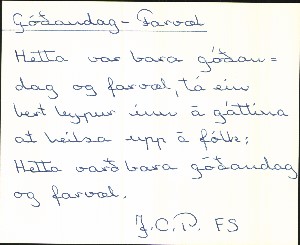
Góðandag – Farvæl. This was just góðandag and farvæl, when someone merely pops in to say hello: Hetta var bara góðandag og farvæl. J.C.P. FS